
The Bridge jumpers
Please note that this blog post discusses suicide attempts on the Sydney Harbour Bridge shortly after its opening. Don't read further if you would find this distressing.
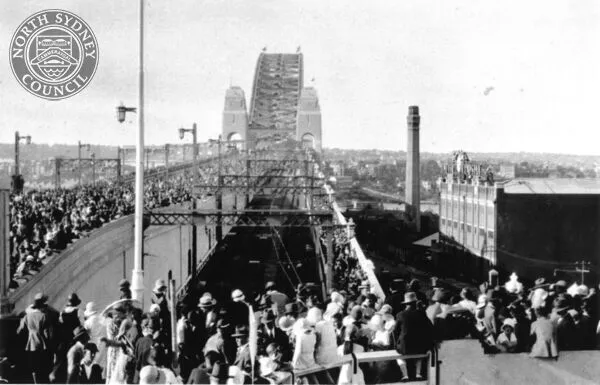
19 March 1932 was a red-letter day for Sydney, as the long-anticipated Harbour Bridge opened to the public. Jubilant celebrations marked the occasion. A million people turned out to watch the ribbon-cutting and the processions, and to travel across the bridge for the first time by train, tram, car or on foot.
At its completion, the Sydney Harbour Bridge was the world’s largest and most expensive. It had run to over £6 million—three and a half times the original estimate—with the debt not fully paid off until 1988. Even so, Sydney needed the bridge. By the 1920s ferry traffic between north and south Sydney was at breaking point, and North Sydney could not grow without a fixed link to the south.
J.C.C. Bradfield, Chief Engineer for the State Government’s Department of Works, was appointed to design and oversee the project. His choice of an arch bridge was elegant and comprehensive. It was not simply a bridge, but the centrepiece of an integrated transport network for trains—including the recently opened underground line—trams, road vehicles, and pedestrians.
Straddling the majestic harbour, it was also the most beautiful bridge in the world. Travellers felt as though they were on the edge of the world. The project, from the Act of Parliament to the opening ceremony, took ten years. Work began in the prosperous years following the Great War, but the final phase was at the depths of the Great Depression, with a third of the men in the city out of work. Known as the Iron Lung, it provided steady employment for hundreds of locals, though at a steep human cost: sixteen dead and many more injured.
For those interested in the bridge’s fascinating construction, I explore it in more depth in my historical novel, An Attractive Naivety. The story introduces Kathleen Butler, Bradfield’s Confidential Secretary—a rare position for a woman at the time—whose work was vital to the project. Newspapers at the time referred to Bradfield as the father of the bridge and Butler as its godmother.
The euphoria of the bridge’s opening was short-lived though, as the bridge soon attracted those seeking a grimmer form of communication. Barely a month passed by before William Lewis, a 49-year-old pensioner burdened with physical and psychological wounds from the Great War, climbed onto the handrail at the middle of the bridge. After straddling it for a few seconds, his feet swinging freely, he let himself fall outwards and dropped 180 ft, hitting the water with the flat of his back. A doctor later suggested he may have died of a heart attack during the fall. Passers-by had paid him no heed, assuming he was a bridge worker. Newspapers the following morning reported the suicide in full.
The next evening a second man, likely stirred by those reports, leapt from exactly the same spot. After stepping to the railing he took off his pullover, handed it to a woman walking nearby, and said, “Here, take this. I won’t have any use for it now.” The nonplussed woman accepted it mechanically, then screamed as he climbed up and went over, hitting the water with a tremendous splash. Water Police were immediately notified but, despite hours of searching with searchlights, could not recover the man’s body.
The first female victim, Alberta Joyce Elks, aged twenty-four, threw herself off the bridge on 24 June. Water Police recovered her immediately after she resurfaced. She managed to say she was depressed and tired of life before succumbing to her injuries a few hours later. She left a husband and two children, including an eight-week-old baby. She had been discharged from an institution only five days earlier, where she had been treated for depression.
Others continued to follow. By the end of 1932, twenty-two people had attempted to take their lives from the bridge. Twenty died; but two were stopped before they could jump. One was an eighteen-year-old boy who had recently secured work. He had just climbed the rail when a passer-by overpowered him and handed him to police who took him to the Reception Home. In October, a young woman hired a taxicab in Darlinghurst at one in the morning and asked to be driven to North Sydney. On the bridge she told the driver to stop, crossed the railing near the tramline and started to climb over. Sensing her intent, the taxi driver sprang from the cab and seized her. She tried to break free, saying, “Let me go. I want to jump over. I am going to join my little girl.” He restrained her until a constable arrived to take her to the station.
Just before Christmas 1932 there was a spike of five suicides in ten days. The bridge was quickly gaining a grim reputation as Sydney’s preferred jumping place, overtaking The Gap at South Head, which had grown eerily quiet since the bridge opened. The media capitalised on these tragedies. Reports of despair sold papers, and each syndicate kept its own running tally of jumpers, maintained with varying degrees of accuracy. For some readers, amid the harsh economic, there may have been a sordid sense of consolation in knowing there were other poor souls in worse circumstances, driven to end their lives.
The suicide attempts were playing havoc with the ferry services. Pilots were forced to divert their vessels to retrieve corpses until the Water Police launch arrived, causing disruptions to the timetables. Passengers crowded the decks hoping to get a glimpse of the next unfortunate figure falling from the span.
Editorials debated how to stop the spate of suicides. A constant patrol of watchers or fencing off the paths might work, but would greatly add to the maintenance costs. With tax revenue diminished and the State already relying on tolls to repay the bridge’s construction debt, there was little appetite for additional expense.
Politicians appeared at a loss. The Minister for Transport, Mr Michael Bruxner, was asked whether the Government would consider placing netting over the railings. He sidestepped the issue and instead attacked the newspapers for giving the suicides so much publicity. Even if the bridge were fenced and guarded, he argued, there were countless other places to take one’s life: The Gap, the long coastal cliffs, or any number of tall buildings. In his view, fencing the bridge would be futile.
The hope was that the financial crisis would ease and prosperity return. This would be the best preventative.
But the Great Depression dragged on through 1933, and the rate of jumpers did not abate. In that twelve-month period there were twenty-nine attempts—averaging more than one a fortnight. Eighteen men died, as did eight women. John Richardson, a 44-year-old from Bankstown, jumped on 2 February after losing all the money he had invested in a poultry farm. Ambrose Thomas, a 33-year-old employee of the Atlantic Oil Company, travelled from Nowra to Sydney on 16 May to throw himself from the bridge, fearing he was about to get the sack. Brian Angell—reputedly a nephew of the late Sir Arthur Conan Doyle and a scholar of some note—jumped on 20 November. He had been unemployed for some time.
Not all who took their lives were driven by economic hardship. Some young women, as noted earlier, suffered post-natal depression or were overwhelmed by grief after the loss of a child. The City Coroner heard the case of Edith Lee, a thirty-three-year-old mother of a seven-month-old baby. She had gone shopping in Sydney with her husband. After handing her baby over to him, she entered the shop. Her husband never saw her again. He searched for her for several hours before learning she had gone over the bridge. Five days earlier, a young woman with a 10-month-old baby tried to hurl her child and herself from the bridge, and was stopped just in time.
Elderly people also turned to the bridge as they battled with debilitating illnesses for which there was no cure. Equally tragic were the war veterans, some missing limbs and still suffering from their wounds, unable to shake off their despondency. The Great War continued to claim lives long after the cessation of hostilities.
Police resources were stretched. Commissioner Walter Childs said officers were doing all they could, but it was impossible to line the parapets with men, though at present that seemed the only sure way to prevent suicides.
If the Government appeared content to look the other way, the Salvation Army actively sought solutions. Colonel Orr, head of the New South Wales branch, recounted a method he had seen while stationed in Japan. A railway crossing with a high suicide rate had been transformed after two nearby Salvation Army missionaries posted a sign: “Stop! Wait a minute. Before doing anything rash, call and have a chat with the lady and gentleman who live in the adjoining houses.” Suicides there practically ceased.
A similar notice at Ben Buckler, Bondi beach, was also effective, but Vaucluse Council would not permit one at The Gap. In September 1933 the Salvation Army lobbied the State Government to provide a safety fence on the bridge footway, but the request was rejected.
Pressure continued to mount. The City Coroner, Herbert Farrington, publicly demanded action to stem the tide of bridge suicides. He proposed a fine wire mesh fixed to the parapet. The Government’s first response was that such a safety fence would not stop a reasonably active person from climbing the railing.
Even so, Department engineers were instructed to develop some device which will not only act as a deterrent, but also place physical obstacles in the path of anyone attempting to climb over the parapet.
By late November 1933, when deaths from jumping had reached forty-five, the Government approved a motion to erect barriers along the footways. At an NRMA meeting, Dr Antill Pockley, on hearing of the decision, expressed the hope that any protective barrier would not spoil the view. Another speaker agreed that a fine mesh along the latticed railings would be effective, preventing anyone a foothold. Alderman Dunningham, Minister for Labour and Industry, said the Main Roads Board already had the matter in hand and had considered a wide range of suggestions from the public. Not all could be taken seriously. Among the more fanciful were proposals to lower the bridge so that the drop not prove fatal, or to suspend a net under the bridge to catch anyone who went over.
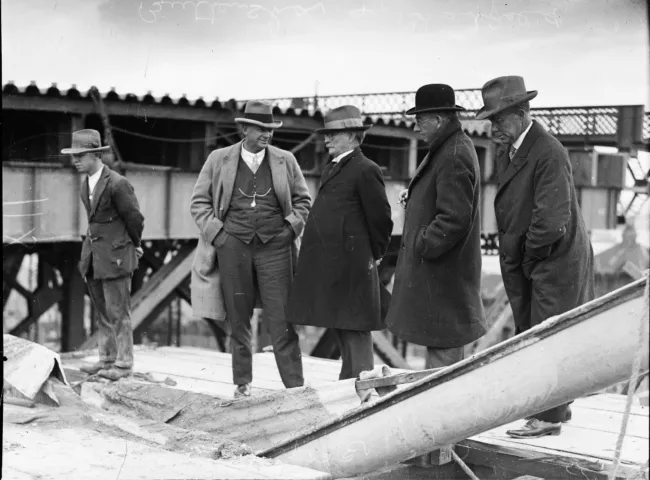
The Department engineers settled on wire netting to be fixed to the railings, and to a framework overhead. Four miles of wire netting would be needed.
By the end of January 1934 the safety barrier was in place. Complaints about its appearance followed at once. A correspondent to the Sydney Morning Herald on 26 January 1934 regretted that a neater job had not been made of it, asking why large, rough nuts were placed inside the lattice fencing rather than the outside. The rough manner in which the netting had been wired to the ironwork was also criticised.
It may have detracted slightly from the bridge's aesthetic, but the safety barrier proved a sound deterrent. It largely broke the grim run of suicides. On 25 February 1934 a man trying to clamber over the safety fence was slowed enough for three boys crossing the bridge to restrain him until police arrived. Another man, in May 1935, climbed onto the fence, but a piece of wire caught his sleeve and held him until a passer-by pulled him back. Suicides, previously averaging more than one per fortnight, fell to a trickle of one or two a year during the rest of the 1930s.
By the second anniversary of the bridge’s opening—now with its safety barrier in place—63,640.000 people had crossed it: 26,000,000 by train, 16,000,000 by road vehicle, 18,000,000 by tram, and 3,640,000 on foot.
**The descriptions and statistics of suicide attempts from the bridge were gleaned from newspaper articles of the time. See here for my research data.
Add new comment