
Miss Kathleen Butler: godmother of the Sydney Harbour Bridge
The Sydney Harbour Bridge serves as a leading motif in my historical novel, An Attractive Naivety. In describing the construction of what was then the largest bridge in the world, I introduce a remarkable young woman who would later be known as the bridge's godmother - Kathleen Muriel Butler.
Kathleen Butler joined the New South Wales Department of Public Works in Sydney as a typist and stenographer in 1910 at the age of nineteen. In the years that followed, she came to the attention of John Bradfield, the Department's star engineer. In late 1922, Bradfield appointed Kathleen Butler as the first member of his newly formed Sydney Harbour Bridge and City Transit Branch. Her rise was unusual. A country girl with only a high school education and no formal technical qualifications, she nevertheless became an indispensable member of Bradfield's team, as his confidential secretary.
As his confidential secretary, she handled correspondence with tenderers, members of the New South Wales Legislative Assembly, and later the contractors themselves. The role demanded not merely clerical competence but a thorough understanding of the bridge's technical specifications, and the ability to explain them clearly to non-specialists, including ministers of parliament.
When Bradfield sailed overseas to elicit interest in prospective tenderers, Butler was given the task in his absence of supporting the passage of the Sydney Harbour Bridge Act through NSW Parliament, preparing the explanatory notes that accompanied the bill. She also responded to inquiries from prospective contractors. She received an honorarium of £25 in recognition of these extra services on 19 December 1922.
Butler assisted Bradfield in preparing the formal specification for the bridge. In the preface of his 1924 doctoral thesis, Bradfield acknowledged Butler's contribution directly, noting that she was his only assistant and that the arrangement of the specification was her work. He wrote that it would be difficult to find a better arranged or printed specification.
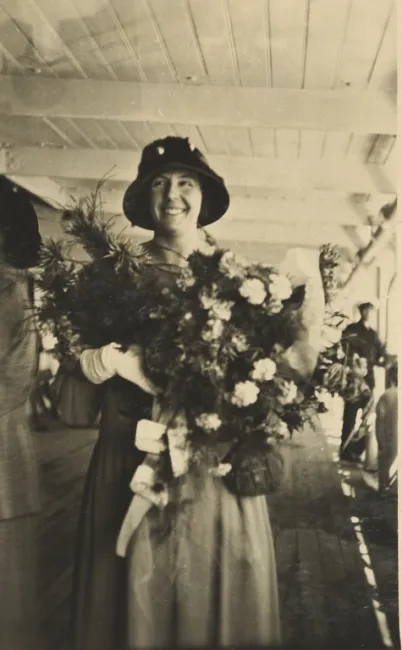
Butler became a public face of the project. Her regular articles in the Sydney Mail based on Bradfield's notes informed the Sydney public of the bridge's progress and were widely read. She attracted considerable press attention in Australia and Britain. At a time when civil engineering projects were almost entirely a male domain, her prominent role drew notice. Butler was depicted as 'a typical Australian girl,' who enjoyed sports and the outdoors, and yet could understand the complex technical specifications of the bridge.
Butler remained involved with the project until her resignation from the Department of Public Works on 6 July 1927, when she married Maurice Hagarty, a grazier from Cunnamulla in Queensland.
In sum, Butler ran an exceptionally efficient office and proved highly effective in managing communications with a wide range of stakeholders, including government officials, contractors, engineers, and the general public. Some modern accounts describe her as an engineer (e.g. Julie Power in the Sydney Morning Herald on 6 August 2024). This is an exaggeration. She held neither formal engineering qualifications nor authority over construction. Her contribution was different, but no less valuable, being an able administrator and publicist at the centre of one of Australia's greatest engineering undertakings.
It should be noted that Kathleen Butler did have a younger brother Roger (born 1897) who did become a formally qualified civil engineer and also worked on the Bridge. He was transferred to Bradfield's team on 1 January 1928, i.e. just after his sister's departure.
Sources
David Gormley-O'Brien, An Attractive Naivety: Australia as a new nation in a complex world, Revised Edition (Nihil Alienum, 2026)
Kathleen Muriel Butler - Engineering Heritage Australia
J. C. C. Bradfield, The City and Suburban Electric Railways and the Sydney Harbour Bridge, Doctoral Thesis, University of Sydney, 1924 https://nla.gov.au/nla.obj-328029755
Roger Butler The People who Built the Bridge, Engineering Heritage Australia
Add new comment