
Second World War

The Second World War was a defining event in modern Australian history. This topic explores the experiences of servicemen and women, civilians, prisoners of war and internees, and examines how the conflict transformed Australia's society, international relationships and national identity.
List of accused at Morotai war crimes trials
This database lists Japanese prisoners of war accused of war crimes in the Australian military trials conducted on Morotai between November 1945 and February 1946. It records the names, ranks, military units, charges, trial references, sentences and, where applicable, the dates and locations of executions, drawing on official Australian military records and contemporary historical sources. The database provides a valuable research tool for historians, genealogists and family researchers investigating Australia's early post-war war crimes programme and the administration of military justice in the South-West Pacific.
Note: Accused war criminals with a (2) against their name indicates that they were also tried for a second war crime at Morotai.
Japanese Cowra Trials - box 1 part 4
Japanese Cowra Trials [enquiry into the death at Cowra Prisoner of War Camp, of Harry Doncaster, Charles Henry Shepherd, Benjamin Gower Hardy and Ralph Jones, and a number of Japanese prisoners of war; charges against PWJA 145535 Sgt/Maj Kanazawa, Akira]
From Garage Experiment to Jungle Legend: How a young Australian created the Owen machine gun
On Radji Beach
Ian Shaw’s *On Radji Beach* recounts the sinking of the *Vyner Brooke* and the massacre of Australian Army nurses and other survivors by Japanese troops on Bangka Island in February 1942. Centred on sole nurse survivor Vivian Bullwinkel, it examines the victims’ ordeal, the evidence surrounding the killings and the enduring legacy of the massacre.
The Fighting at Palembang in February 1942
English translation of Nortier's article on the Japanese invasion of Palembang in February 1942
List of war crimes tried at Morotai (Nov 1945 - Feb 1946)
This database lists the war crimes prosecuted by Australian Military Courts at Morotai between November 1945 and February 1946. Organised by individual case rather than by accused, it identifies where each offence was committed, the nature of the crime, and the corresponding trial references. The cases include the murder and mistreatment of Allied prisoners of war, the execution of captured RAAF airmen, torture, and other violations of the laws and customs of war committed across Ambon, Halmahera, New Guinea, the Talaud Islands and northern Celebes. Together, these records provide an overview of the offences investigated by Australian authorities as part of the first stage of Australia's post-war war crimes programme in the South-West Pacific.
Japanese Cowra Trials - box 1 part 2
Japanese Cowra Trials [military Court trial of PWJA 145648, Yoshida, Hiroshi and PWJA 145535, Kanazawa, Akiro / Akira, 12 Prisoner of War Camp, Cowra] [2.0cm; box 1]
Australia's first war crime trials
White Coolies
Betty Jeffrey’s *White Coolies* is a firsthand account of the Australian Army nurses imprisoned by the Japanese in Sumatra from 1942 to 1945. Based on her wartime diary, it records the women’s hunger, disease, forced labour and repeated transfers between camps, as well as the courage, humour and mutual support that helped them survive.
Prisoner-of-War Diary of Gordon Stanley Reis
Captured by the Japanese off Sumatra on 18 May 1942 - press-ganged into working at Pladjoe BPM refinery after Japanese occupation of Palembang
Japanese Cowra Trials - box 1 part 8
Japanese Cowra Trials [outbreak of Japanese prisoners from Cowra Prisoner of War Camp, 5 August 1944 and arrangements for the inquiry
Ashes and Sakura: an Australian story of the making of a Pacific nation
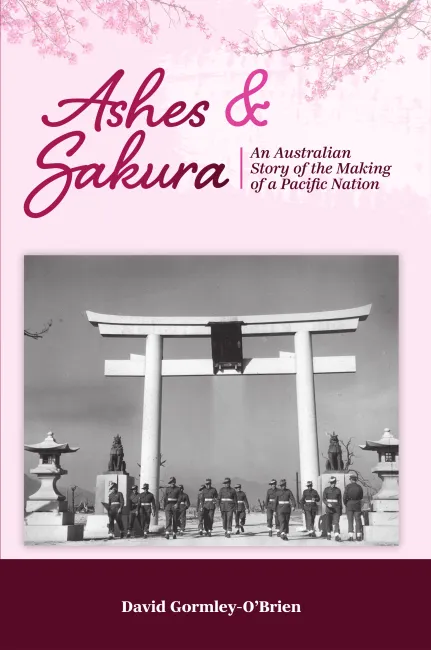
Set against the remote Pacific island of Morotai and the ruins of postwar Japan at war’s end, Ashes and Sakura follows Tom Darcy, a young Australian soldier serving with the British Commonwealth occupation forces in Japan after the Second World War. As he encounters the devastation of a defeated nation and forms unexpected bonds with those on the other side of the conflict, the novel explores war, memory, love and reconciliation.
The Camps at Belalau and Liberation
Belalau Camps, Loeboek Linggau, Lahat, Sumatra
Based on research by Judy Balcombe
Duncan Robertson. Singapore 1942
Robertson's account of his wartime experiences including being interned in Palembang and working at Pladjoe
Civilian Internees Camps in South Sumatra during the War
A timeline of mens' and womens' internees camps in South Sumatra
Japanese Cowra Trials - box 1 part 3
Japanese Cowra Trials [inquisition held by the Coroner at the Court House and the Prisoner of War Camp at Cowra, 11-15 December 1944; 3 copies] [0.5cm each copy; box 1]
Sources for Japanese breakout from Cowra Prisoner of War Camp
Earlsford Bates VX22042 Service Record
Service record of Earlsford Bates
Dutch East Indies diaries and personal documents: EB van Dam
Diary February 13, 1942 - January 8, 1945 of Mr. EB van Dam (March 15, 1899 - October 7, 1970)
The BPM employee in Pladjoe, Emanuel Benjamin van Dam (Groningen, 1899), was interned in the Mulo school in Palembang in April 1942, in the Prison in Palembang from April 15, 1942, and in January 1943 in Poentjak Sekoening in Palembang. From September 1943 in the Prison in Muntok and from March 1945 in Belalau. In September 1945, he was transferred to hospitals in Johor Baru and Singapore.
Japanese Cowra Trials - box 1 part 5
Japanese Cowra Trials [transcript of Inquiry into deaths at Japanese Prisoner of War Camp, Cowra, heard 11-15 December 1944 by the Coroner at Cowra
Pacific reckoning - Australian war crimes trials (video)
The invasion of the Dutch East Indies
Between 1966 and 1980, the War History Office of the National Defense College of Japan published the 102-volume Senshi Sōsho (War History Series). These volumes give a detailed account of the operations of the Imperial Japanese Army and the Imperial Japanese Navy during the Second World War. This book, vol. 3 of the series, describes in depth the campaign to gain control over the Indonesian archipelago. (copyright: the Corts Foundation)
Roy Gillam WX10456 Service Record
Service record of Roy Gillam
Interview with Mamie Freda Colley
British civilian teacher served as Queen's Army Schoolmistress with Army Education Corps in GB, Germany and Singapore, Malaya, 1926-1942; internee in Muntok Internment Camp, Bangka Island, Bukit Besar, Irenelaan and Poentjak Sekoening Barracks Internment Camps, Palembang and Loeboek Linggau Internment Camp, Sumatra, Dutch East Indies, 2/1942-9/1945
Japanese Cowra Trials - box 1 part 6
Japanese Cowra Trials [charges against PWJA 145535 Sgt/Maj Kanazawa, Akira, Cowra Prisoner of War Camp, abstract of evidence] [2.0cm; box 1]
War Crimes Trials on Morotai Island - WW2TV (video)
Petroleumscape as Battleground: Pladjoe, Pearl in the Crown of the Bataafsche Petroleum Maatschappij (BPM/Shell) in the Dutch East Indies
Oil fields can easily turn into battlefields. This happened more than once in the former colony of the Dutch East Indies (Nederlands-Indië, now Indonesia) in the turmoil of the 1940s, when Japanese, Dutch, Allied, and Indonesian forces fought fierce battles over the control of
local oil facilities—with good reason, because in the 1940s the Dutch East Indies was one of the world’s biggest oil exporters. Centered on the oil industry city of Plajoe, this portion of the global petroleumscape, a multilayered network of spaces made possible by petroleum
and facilitating its flow, was designed to support a country on the other side of the world.
It was then reshaped by war and revolution, in the context of changing global actors. This chapter tells a largely unknown story about the construction, destruction, and reconstruction of the petroleumscape in what is now the province of South Sumatra in Indonesia. It is
a story of how oil fields can become battlefields and of how even in peacetime a petroleumscape is shaped by attempts to protect and defend sources of wealth and power.
Japanese Cowra Trials - box 1 part 1
Japanese Cowra Trials [military Court trial of PWJA 145648, Yoshida, Hiroshi, 12 Prisoner of War Camp, Cowra] [12 pages; box 1]
An Attractive Naivety: Australia as a new nation in a complex world (Revised Edition)
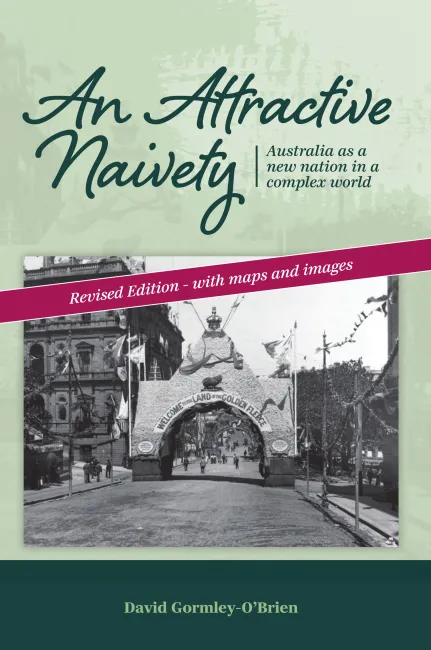
An Attractive Naivety is an epic work of Australian historical fiction spanning the first half of the twentieth century. Through the lives of ordinary men and women, it traces the nation’s journey from Federation and plague to Depression, war, and uneasy peace. Interweaving fictional characters with real events, the novel explores the humour, hardship, courage and contradictions that shaped modern Australia.
Prelude to the Monsoon: Assignment in Sumatra
Through the eyes of young Major Jacobs, a full view emerges of the "boiling cauldron" that was Sumatra in 1945. In spite of the official Allied victory, Jacobs had to attempt to rule Sumatra using the existing Japanese military structure until British relief arrived.
Battle for Palembang
An account of the Allied defence of Palembang, Sumatra, against the Japanese invasion in February 1942, focusing on the strategically vital Pladjoe and Soengei Gerong oil refineries, the Japanese airborne assault, and the desperate Allied attempts to defend and destroy the installations before withdrawing from southern Sumatra.
Japanese Cowra Trials - box 1 part 7
Japanese Cowra Trials [inquisition before the Coroner, held at the Court House and the Prisoner of War Camp at Cowra 11-15 December 1944, and statements dated 31 October 1944] [1.0cm; box 1]
Holland. Rotterdam. May 12
A wartime report on the German invasion of the Netherlands in May 1940, including Dutch claims of an orderly military withdrawal, fighting around Rotterdam and continued Allied support. The article also reports allegations that German forces used nerve gas to capture a fort on Belgium’s Albert Canal.
Gift of Tea for the Dutch, Delivered by the R.A.F.
In April 1941, the RAF dropped 75,000 one-ounce packets of tea over the occupied Netherlands. Donated by Dutch East Indies tea planters, the packets carried the Netherlands flag and an encouraging message from the free Netherlands Indies to the Dutch people.
MAGNA CARTA OF 1941
The article welcomes the **Atlantic Charter of 1941**, agreed by Winston Churchill and Franklin D. Roosevelt, as a major statement of Anglo-American war aims and principles for the post-war world. It emphasises continued American support for Britain, international economic co-operation, improved living and labour standards, disarmament of aggressor nations and opposition to territorial conquest. The article also stresses the Charter's relevance to Japanese expansion in the Far East and presents it as the basis for closer British, American and Russian co-operation against the Axis powers.
DUTCH ARE AT WAR WITH JAPAN
The Dutch East Indies declared war on Japan following the Japanese attacks against the United Kingdom and United States in December 1941. The colony mobilised its forces, interned Japanese nationals and prepared to defend its strategically important oil resources. Dutch officials expressed confidence in their aircraft, submarines and strengthened defences.
Balikpapan Taken But No Oil
Japanese forces captured the important Borneo oil port of Balikpapan after Dutch troops destroyed its wells and installations under a scorched-earth policy. The Dutch ignored Japanese threats to execute those responsible, leaving the invaders without access to the area’s oil.
Native Seamen's Strike Creates Police Problem
More than 600 mainly Javanese seamen in Sydney refused to sail their vessels, leading to mass arrests and prosecutions for being absent without leave or disobeying their masters. Many declared that they wanted to return to Java and chose imprisonment rather than comply, with 130 men each fined £10 or sentenced to 20 days in gaol. The dispute caused serious concern about disruption to Netherlands East Indies shipping and required extensive police intervention.
Italians Employed on Farms in the Coonabarabran District
More than 40 Italian prisoners of war were employed on farms in the Coonabarabran district to ease wartime labour shortages, with numbers expected to double. While local farmers reportedly praised the prisoners' work and conduct, the scheme drew criticism from some who argued that Australian servicemen with farming experience should have been released to work the land instead.
COWRA, NSW. 1944-07-01. JAPANESE PRISONERS OF WAR PRACTISING BASEBALL ON THEIR SPORTSGROUND
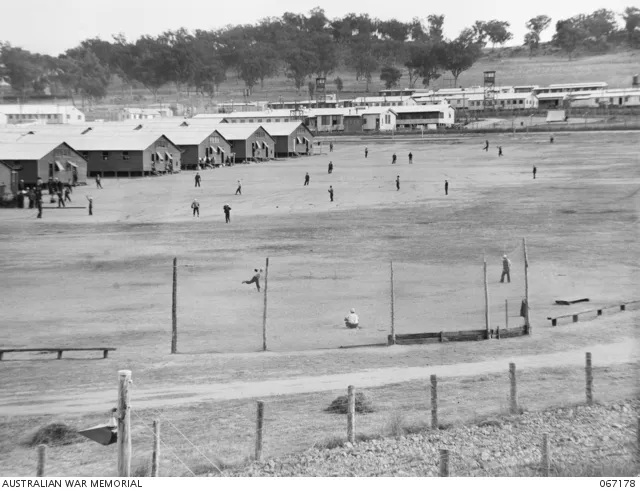
Japanese prisoners playing baseball in B Compound, Cowra POW Camp.
COWRA, NSW. 1944-08-05. THE MORNING AFTER THE OUTBREAK REVEALED DEAD BODIES LYING EVERYWHERE
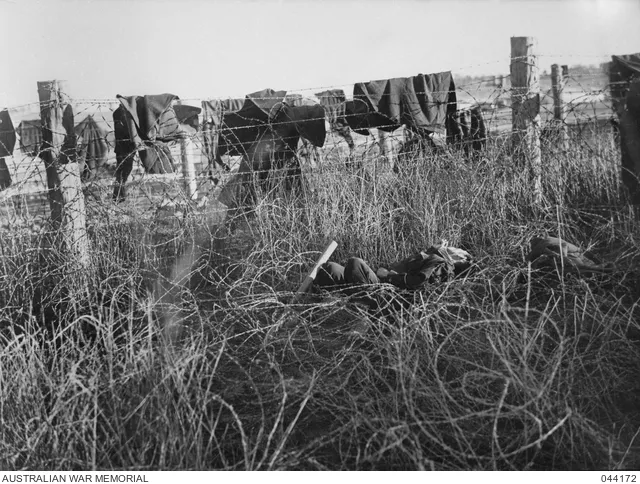
Aftermath of mass Japanese POW breakout at Cowra - bodies entangled in barbed wire
COWRA, NSW. 1944-08. BLANKETS THROWN OVER THE BARBED WIRE IN B CAMP, (THE JAPANESE SECTION)
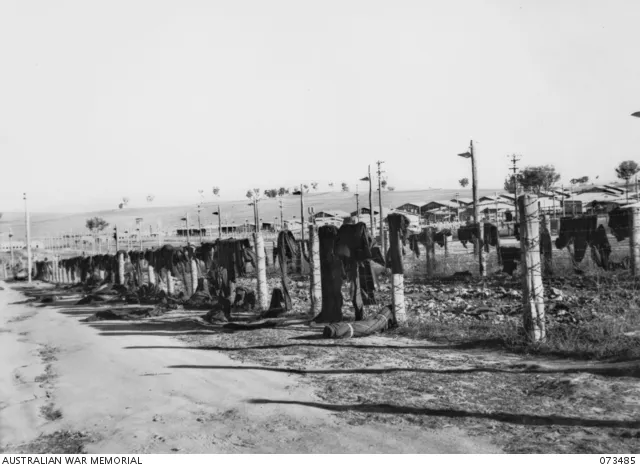
Aftermath of mass Japanese POW breakout at Cowra - blankets over barbed wire
Cinesound Review - first pictures of massacre survivors
An excerpt from Cinesound Review which shows footage of Australian army nurses in a Singapore hospital after their rescue in 1945.
Japanese prisoner-of-war camp Morotai
Japanese prisoners held in POW camp at Morotai
Wife Accused of Taking Italian POW as Lover
A Sydney company director petitioned for divorce, alleging that his wife had committed adultery with an Italian prisoner of war employed on his family's farm near Oberon. The wife denied the allegation, while the prisoner admitted to acts of familiarity but denied adultery. Evidence was heard from the farm manager and the case was adjourned for further hearing.
Sentences from Court Martial trials at Medan
Sentences of courts martial in Medan received from Dutch authorities. Trials concerning the ill treatment of PW and internees including Australian nurses and at Pakanbohoe Camp in Sumatra
This is Your Life: Vivian Bullwinkel
An excerpt from the series This is Your Life, hosted by Roger Climpson with Vivian Bullwinkel.
Vivian Bullwinkel interviewed by John Clements [sound recording]
Vivian Bullwinkel interviewed by John Clements on ABC radio 1980
Every Inch of the Way: Vivian Bullwinkel
Documentary made for the Department of Veteran's Affairs - Vivian Bullwinkel discusses her experiences in being transferred from one camp to another.