
Today's migrants ... tomorrow's Australians
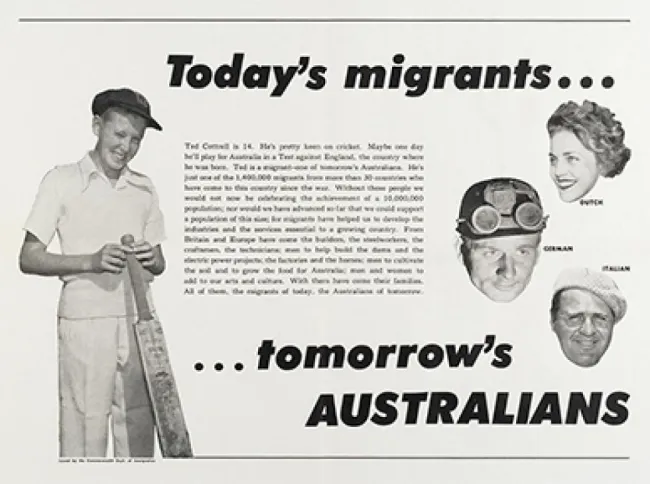
This poster, titled Today's migrants…tomorrow's Australians, shows a young man posing with a cricket bat, as well as three people identified as Dutch, German and Italian. The poster provides information about the advantages of accepting migrants to Australia. It was issued by the Department of Immigration, as sighted in the bottom left-hand corner.
The Department of Immigration was established in 1945, at the end of World War II. The main aim of the department was to increase Australia's population for defence and economic reasons. As seen in the poster, British people were considered the most desirable candidates for immigration, but the government soon realised that it would be necessary to source 'suitable' migrants from other European countries. The department established migrant-processing centres overseas, and chose migrants based on their skills and prospects of assimilating in Australia.
In 1947, a total of 97 percent of people in Australia were either born here or in Britain. This was partly a result of the Immigration Restriction Act 1901 and the White Australia policy. Many Australians feared that new migrants would take their jobs and jeopardise the British-based Australian way of life. The Department of Immigration set out to allay such concerns by promoting the merits of migrants. It described them as 'New Australians' or 'Tomorrow's Australians', which suggested that they would readily take on Australia's culture and identity. The department also highlighted the importance of new migrants taking on employment in what Australians considered 'dirty jobs'.
The Department of Immigration had expected that migrants would assimilate within one or two generations. It considered that, through immersion in the community, migrants would learn English and abandon their own language and culture. Many migrants had difficulties speaking English, which precluded them from building relationships with other Australians. They experienced racism, such as name-calling, and witnessed the preferential treatment of British-born Australians. This often saw migrants move into neighbourhoods where people shared their language and culture, and establish clubs based on their country of origin.
This poster was one of many promotional campaigns created to convince the public that immigration was good for Australia. Post-war migrants laid the foundation for the nation's continued economic growth. Migrants provided both the workers and the market for products, which saw the output of Australia's factories exceed that of its primary industry for the first time. Projects such as the Snowy Mountains Hydro-electric Scheme depended on migrant labour. This project saw 70,000 migrants construct 16 major dams, 145 kilometres of tunnels and pipelines, and seven power stations.
https://recordsearch.naa.gov.au/SearchNRetrieve/Guest.aspx?Location=SNRItemDetailMain&Key=13099578