
Post-war Migration to Australia
Post-war migration transformed Australia’s population, workforce and national identity. Government immigration schemes brought displaced persons, refugees and other migrants from Europe, many of whom contributed to major projects such as the Snowy Mountains Scheme while adapting to Australia’s policy of assimilation.
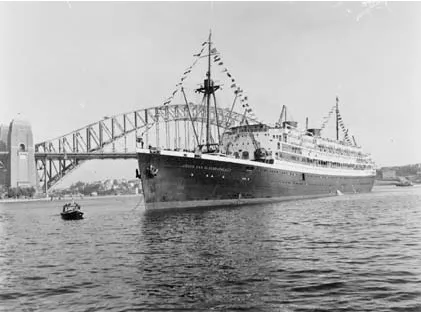
MS Johan van Oldenbarnevelt – Dutch emigration ship to Australia
The motor ship Johan van Oldenbarnevelt, widely remembered as the JVO, was one of the most important vessels in the history of post-war Dutch migration to Australia.
Originally built as a prestigious passenger liner for the Netherlands–East Indies service, she subsequently served as an Allied troopship before being converted to carry emigrants. Between 1950 and 1958 she operated under charter in the Australian migrant trade, bringing thousands of Dutch and other European emigrants to Fremantle, Melbourne and Sydney.
After the migrant charter ended, Johan van Oldenbarnevelt continued visiting Australia as a passenger and round-the-world liner until 1963. For the families who travelled aboard her, the ship became closely associated with departure from the Netherlands and the beginning of a new life in Australia.
Dutch Australian Cultural Centre
The Dutch Australian Cultural Centre (DACC) was founded in 1983 to provide a central organisation to preserve the rich Dutch history in Australia. Over the years the organisation has developed as a research and resource centre for study on the contributions of the Dutch to Australia. The DACC has rich collections in its reference library and archive, and is engaged in a range of activities. The Centre has hosted lectures and symposia, as well as exhibitions about Dutch maritime, migration, military and merchant history in Australia.
Dutch migration and the Snowy Mountains Scheme: work, community and nation building
The Snowy Mountains Hydro-Electric Scheme occupies a central place in Australia’s postwar history. Conceived as a nation-building project, it reshaped Australia’s energy and water systems while simultaneously transforming the country’s demographic profile. Between the late 1940s and the 1970s, the Scheme attracted tens of thousands of workers, the majority of whom were migrants from Europe.
Among them were Dutch migrants who arrived in Australia during the large postwar migration wave of the 1950s. Although never organised as a distinct national contingent, Dutch workers formed a visible and active part of the Snowy workforce and the communities that developed around it. Their involvement illustrates how Dutch migration combined labour, social life and long-term settlement in Australia.
Records of Dutch migration held in Sydney
Many Dutch people migrated to Australia in the wake of World War II. Many Dutch people lost their lives during the German occupation and Allied bombing and as Europe was facing economic and social devastation, survivors were encouraged by the Dutch and Australian governments to come to Australia. The Netherlands Australia Migration Agreement (NAMA) of 1951 facilitated the immigration of Dutch people to Australia, including those residing in the Netherlands East Indies.
Johan van Oldenbarnevelt in Sydney Harbour 1958
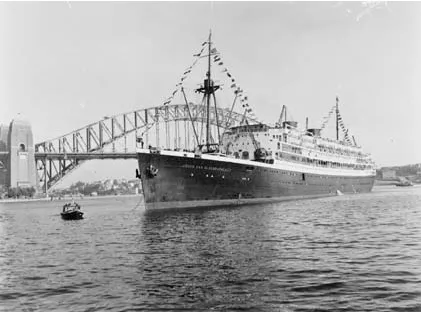
The migrant ship Johan Van Oldenbarnevelt on its last migrant voyage in 1958.