
The 'Black Armada' - Australian boycott of Dutch ships in 1945
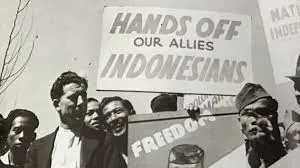
For most of the first half of the twentieth century, Australians knew little about their nearest northern neighbour, Indonesia, or its seventy million inhabitants. They may have been vaguely aware that the archipelago of tropical islands and active volcanoes was a Dutch colony that generated enormous wealth for its colonial rulers through oil, rubber and other natural resources.
Beyond that, however, there was widespread ignorance about the people of the Netherlands East Indies (NEI) and what life under Dutch colonial rule was actually like.
This was about to change. In 1942, the Japanese invasion and occupation of the NEI brought the region abruptly into Australian consciousness. Thousands of Indonesians, alongside Dutch colonial personnel and other evacuees, were transported to Australia by the Dutch authorities. Indonesian seamen and dock workers, along with sailors and soldiers connected to the Dutch merchant marine and Royal Netherlands East Indies Army (KNIL), were essential to the Dutch war effort.
The NEI government-in-exile, based near Brisbane, requested that these people and their families be permitted to remain in Australia for the duration of the war. The Australian Government agreed, on the understanding that they would be repatriated once hostilities ended, temporarily relaxing aspects of its White Australia policy that restricted non-European immigration.
Employed by the NEI government-in-exile, Indonesian seamen and dock workers became a visible presence in major ports such as Sydney, Melbourne, Brisbane and Fremantle, where they interacted daily with Australian maritime workers and local communities.
In April 1942, Australian unions supported a strike by around two thousand Indonesian seamen over wages and conditions after they stopped work aboard Dutch vessels operating from Australian ports. The NEI government-in-exile paid Indonesian workers significantly less than Australian servicemen and maritime workers performing comparable duties. The strike disrupted shipping and exposed the extent to which Dutch wartime operations depended upon Indonesian labour. Harsh Dutch attempts to restore discipline, including imprisonment and the application of military law, created unease within sections of the Australian public and government. For many Australians, it provided a direct glimpse into the realities of colonial rule and raised questions about the compatibility of colonial labour practices with Australian legal and industrial standards.
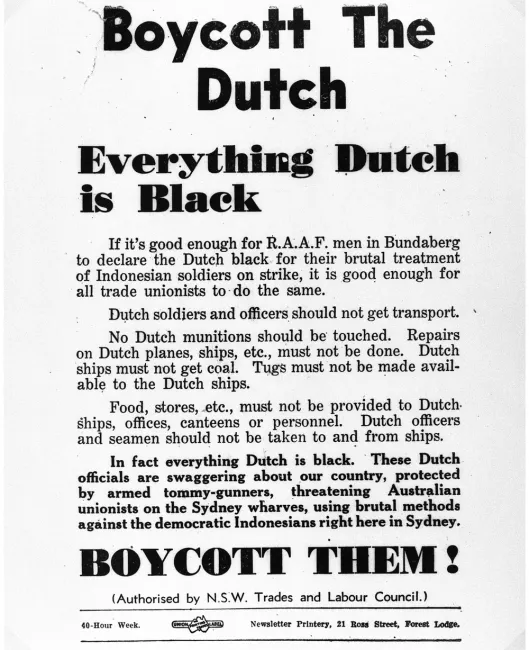
Australian union support for Indonesian workers transformed from concerns over labour conditions in 1942 into political solidarity for independence by the end of the war.
Massive relief operations were launched from Australia to assist the hundreds of thousands of European and Eurasian women and children held in Japanese internment camps across the Indonesian archipelago, many close to starvation. There were also around one hundred thousand Allied prisoners of war who needed to be cared for and repatriated.
In Batavia (now Djakarta), Sukarno had declared Indonesian independence from the Netherlands on 17 August 1945, i.e. two days after Japan accepted the Allied surrender terms. The Netherlands refused to recognise the declaration and sought to reassert control over its colony. It was expected that relief operations would coincide with the restoration of Dutch authority in the NEI, but Australian maritime and waterfront unions responded by launching the so-called Black Armada, refusing to load, crew or service Dutch ships involved in efforts to restore colonial rule in Indonesia.
On 3 September 1945, Indonesian crew members aboard four Dutch ships in Sydney staged a sit-down strike, refusing to serve on vessels they suspected were carrying weapons to suppress the independence movement. The following day, they appealed to the Waterside Workers' Federation of Australia (WWF). In response, on 20 September 1945, the WWF proclaimed the first embargo on Dutch shipping in Brisbane. Similar action soon followed in Fremantle, Sydney and Melbourne, although hospital ships were exempted. Thirty-one trade unions eventually became involved in the boycott, which expanded into air transport, trade, repairs and storage.
In the months that followed, the Black Armada affected nine corvettes, two submarines, seven submarine chasers, thirty-six Dutch merchant vessels, passenger liners and troopships, two tankers, thirty-five oil industry craft, 450 barges, lighters and landing craft, along with aircraft and land transport vehicles. Two British troopships and three Royal Navy vessels were also blacklisted.
On 30 September 1945, five thousand people attended a rally supporting Indonesian independence in the Domain in Sydney. Further demonstrations followed, many supported by churches, demanding that the Dutch honour the principles of self-determination outlined in the Atlantic Charter.
On 20 October 1945, the SS Esperance Bay departed Sydney Harbour for Indonesia carrying hundreds of Indonesian seamen and dock workers eager to join the National Revolution. At the wharf, an Australian union representative presented those returning home with a red-and-white flag of the Indonesian Republic, while crowds joined in chants of ‘Indonesia merdeka’ – Freedom for Indonesia.
Conclusion
By mid-1946, the Black Armada boycott had petered out as the last Dutch ships and warplanes departed Australia. The boycott did not prevent the Dutch reconquest of the NEI, but the delays imposed upon recolonisation ultimately worked in favour of the emerging Indonesian republic.
At the diplomatic level, Australia, under the leadership of H. V. Evatt, Minister of External Affairs, increasingly supported Indonesian self-determination at the United Nations and international forums. This created post-war tensions between Australia and the Netherlands, nations that had cooperated closely as wartime allies.
In 1949, after a bloody war of independence in which estimated deaths ranged from 80,000 to 300,000, the Netherlands formally ceded sovereignty to Indonesia.
Watch Indonesia calling video
References
ANU Archives Library https://archives.anu.edu.au/exhibitions/struggle-solidarity-and-unity-150-years-maritime-unions-australia/black-armada
Beasley, M 1996, Wharfies: The History of the Waterside Workers' Federation, Halstead Press, Rushcutters Bay, 1996.
Budde, P n.d., The Black Armada - One of the Largest Maritime Boycotts Ever, https://paulbuddehistory.com/table-of-content/the-black-armada-one-of-the-largest-maritime-boycotts-ever/
How Australian workers helped Indonesia end colonial rule https://solidarity.net.au/highlights/how-australian-workers-helped-indonesia-end-colonial-rule/
The Black Armada https://www.70yearsindonesiaaustralia.com/shared-history/the-black-armada
Dutch-Australian tensions over Indonesia during and after World War II https://dutchaustralianculturalcentre.com.au/archive/dutch-australian-history/maritime-history/from-colony-to-conflict-dutch-australian-tensions-over-indonesia-during-and-after-world-war-ii/
Black Armada: Australian boycott of Dutch Shipping WWII https://dutchaustralianculturalcentre.com.au/news/black-armada-australian-boycott-of-dutch-shipping-wwii/
Indonesia calling - Joris Ivens, 1946 https://www.youtube.com/watch?v=iAzfM9cQvZQ
Lockwood, R. (1983). Black armada : Australia & the struggle for Indonesian independence, 1942-49 / Rupert Lockwood. Hale & Iremonger.
Blog comments
The year of living dangerously
...by Christopher Koch, pub 1978 to great acclaim. Became a Peter Weir film. It was set in 1965 in Jakarta, the year in which Suharto replaced Sukarno, with perhaps at least 500,000 Indonesian deaths.
I've just read the book. Beautifully done, also harrowing and horrifying and (for me at least) instructive.
CIA, UK and Aus intervention
I agree, Geoff. The 1965 coup d'état was supported by the CIA, UK and Australia as an attempt to eradicate the Communists (PKI) and unseat Suharto, who was believed to be a little too Pinko. I have recently made acquaintance with David Jenkins, former Asia correspondent for various Australian newspapers during the 60s and 70s. He is about to publish his second volume on the life of Suharto and will be covering the coup. Watch this space!
David
David Jenkins and China
In early 1968 I was lucky enough to be one of 57 students in a group that visited China for a month, just 18 months after the start of Mao's 'Cultural Revolution'. There had been a similar group from Australia 12 months earlier. In both those times the country was in turmoil. Our group included Stephen Fitzgerald, one of several in our group who were more-or-less fluent in Mandarin--not including me, a totally naive maths-science nerd! I believe that no further groups were permitted to enter China for some years.
I think, from memory, that David Jenkins was also in our group, and clearly already very knowledgeable about Asia.
I recently read the excellent 'Fly wild swans' by Jung Chang. She set out in great detail what a hideous monster Mao was, responsible for huge numbers of deaths. There are hideous but obvious parallels among Sukarno, Mao, Putin, Trump... and counting, alas.
Fly wild swans
That must have been a very eye-opening experience. The scale of suffering caused by the Cultural Revolution is difficult to comprehend. The question of how autocrats are enabled is one of the great recurring themes of history. They rarely act alone. Their power depends on institutions, ambitious subordinates, fanatical believers, and the majority who think that keeping their heads down is the safest course. Dawkins talks about the selfish gene. I think there is also the sycophantic and opportunistic gene. One doesn't need to look hard to find examples in the world today.
Australian FA
I was really surprised that Australia govt position was not more definitively opposed to the Indonesians in Australia and the independence movement. How did the government align the departure of the SS Esperance Bay with ongoing support of Netherlands colonial rights?
Australian Government sympathies 1945
The Australian Government found itself in a difficult position. The Netherlands had been a wartime ally and Australia formally recognised Dutch sovereignty over the Netherlands East Indies. The government was therefore reluctant to take any action that could be interpreted as openly supporting Indonesian independence.
At the same time, Australian policy was influenced by several competing considerations. Allied Commander-in-Chief Louis Mountbatten was determined that British and Commonwealth forces should focus on disarming the Japanese, recovering prisoners of war and restoring order, rather than becoming entangled in the political dispute between Indonesian nationalists and the Dutch. This encouraged a degree of caution.
Within the Federal Labor Government itself there were differing views. Some ministers and Labor supporters were sympathetic to Indonesian aspirations and believed that the principles of the Atlantic Charter should apply to colonial peoples as much as to Europeans. They found it difficult to reconcile wartime rhetoric about freedom and self-determination with a simple restoration of colonial rule.
It is also worth remembering that support for the Indonesian cause was far from universal in Australian politics. Opposition leader Robert Menzies criticised the Indonesian strikes and the support they received from Australian unions, while Arthur Fadden and others expressed concern that communist influences were active within the nationalist movement.
The departure of the SS Esperance Bay reflected these tensions. Officially, Australia continued to recognise Dutch rights in the colony, but in practice the government was balancing alliance obligations, British strategic priorities, domestic political pressures and growing sympathy for Indonesian self-determination. The result was a policy that was often cautious, sometimes contradictory, and ultimately difficult to sustain as the Indonesian Revolution gathered momentum.
A final point, I should add, is that the White Australian policy, temporarily relaxed during wartime, was to be restored en pleine vigueur at the cessation of hostilities. The Australian Government was keen to repatriate all non-Europeans in the country as quickly as possible, particularly the Japanese prisoners of war and Indonesian seamen and dock workers.
Add new comment