
Dutch East Indies
Articles, books and primary sources concerning the history, society and administration of the Dutch East Indies, including the colonial period, the Second World War and the transition to Indonesian independence.
Workers' housing at BPM in Pladjoe
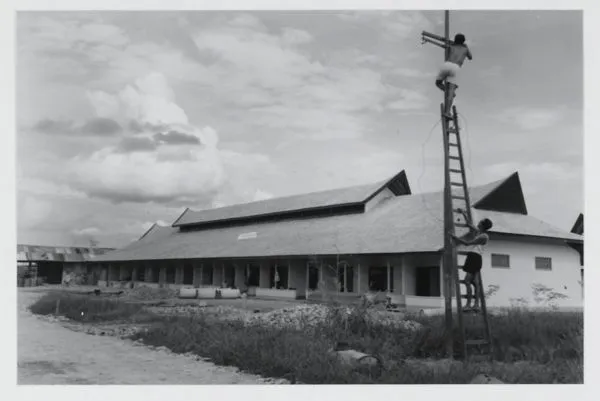
Workers' housing at BPM refinery Pladjoe Palembang, around 1930
Memories of the JVO - MS Johan van Oldenbarnevelt
This feature is going to deal with a wonderful passenger liner that has proved to be a much-loved ship, especially in the Southern Hemisphere. Personally, I remember the day so well, when I boarded her for the first time, and then sadly I watched my beloved JVO leave our shores for the very last time as she departed Wellington New Zealand on January 30, 1963, and I would never see her ever again, except in the News papers with shocking news later in that same year! She departed Sydney Australia on February 3 for her final voyage, which was unofficially to an undisclosed destination, but it turned out to be Naples.
As we will discover in this work this gracious Dutch liner enjoyed six distinctive lives and several transformations during her long and distinguished career. To this day, she is remembered for her rather long and very difficult name, a name that most people had great difficulty in pronouncing. Of course, I have not as yet officially given her full name as yet, only those three capital letters. JVO
Prisoner-of-War Diary of Gordon Stanley Reis
Captured by the Japanese off Sumatra on 18 May 1942 - press-ganged into working at Pladjoe BPM refinery after Japanese occupation of Palembang
Civilian Internees Camps in South Sumatra during the War
A timeline of mens' and womens' internees camps in South Sumatra
BPM Oil Refinery Pladjoe - Palembang
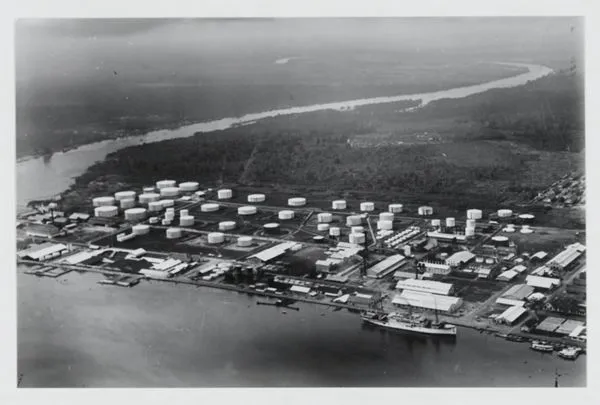
BPM refinery on the Moesi River, Palembang, circa 1930
Isles of the East: An illustrated guide to Australia, Papua, Java, Sumatra etc
In presenting to the reader the first edition of Isles of the East, it is hoped that its pages may prove of interest to those, who seek information regarding Java and the Dutch Indies generally, as a pleasure resort on the one hand, and as a country offering exceptional commercial opportunities, on the other.
Duncan Robertson. Singapore 1942
Robertson's account of his wartime experiences including being interned in Palembang and working at Pladjoe
Beyond the pale: Dutch extreme violence in the Indonesian war of independence 1945-1949
Between 1945 and 1949, Indonesia defended its recently declared independence, and the Netherlands waged its last major colonial war. Much is now
known about this war, but a great deal has also remained unclear or contested. At the end of 2016, the second Rutte cabinet decided to finance a broad-based study on the Dutch military conduct during this conflict. This book presents the conclusions of that study.
Houses probably at Pladjoe Baroe - BPM refinery
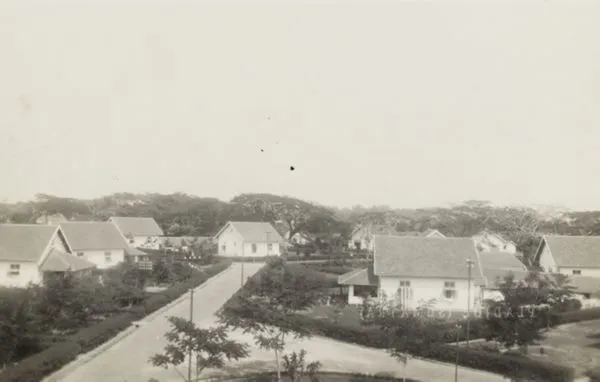
Houses probably in the new European estate at Pladjoe Baroe
Petroleumscape as Battleground: Pladjoe, Pearl in the Crown of the Bataafsche Petroleum Maatschappij (BPM/Shell) in the Dutch East Indies
Oil fields can easily turn into battlefields. This happened more than once in the former colony of the Dutch East Indies (Nederlands-Indië, now Indonesia) in the turmoil of the 1940s, when Japanese, Dutch, Allied, and Indonesian forces fought fierce battles over the control of
local oil facilities—with good reason, because in the 1940s the Dutch East Indies was one of the world’s biggest oil exporters. Centered on the oil industry city of Plajoe, this portion of the global petroleumscape, a multilayered network of spaces made possible by petroleum
and facilitating its flow, was designed to support a country on the other side of the world.
It was then reshaped by war and revolution, in the context of changing global actors. This chapter tells a largely unknown story about the construction, destruction, and reconstruction of the petroleumscape in what is now the province of South Sumatra in Indonesia. It is
a story of how oil fields can become battlefields and of how even in peacetime a petroleumscape is shaped by attempts to protect and defend sources of wealth and power.
Prelude to the Monsoon: Assignment in Sumatra
Through the eyes of young Major Jacobs, a full view emerges of the "boiling cauldron" that was Sumatra in 1945. In spite of the official Allied victory, Jacobs had to attempt to rule Sumatra using the existing Japanese military structure until British relief arrived.
Dutch East Indies diaries and personal documents: EB van Dam
Diary February 13, 1942 - January 8, 1945 of Mr. EB van Dam (March 15, 1899 - October 7, 1970)
The BPM employee in Pladjoe, Emanuel Benjamin van Dam (Groningen, 1899), was interned in the Mulo school in Palembang in April 1942, in the Prison in Palembang from April 15, 1942, and in January 1943 in Poentjak Sekoening in Palembang. From September 1943 in the Prison in Muntok and from March 1945 in Belalau. In September 1945, he was transferred to hospitals in Johor Baru and Singapore.
Revolusi: Indonesia and the birth of the Modern World
David Van Reybrouck’s *Revolusi* traces Indonesia’s struggle for independence from Dutch colonial rule, the Japanese occupation and the revolution of 1945–49. Drawing on extensive research and eyewitness testimony, it places the conflict within the wider history of colonialism, nationalism and global decolonisation.
Interview with Mamie Freda Colley
British civilian teacher served as Queen's Army Schoolmistress with Army Education Corps in GB, Germany and Singapore, Malaya, 1926-1942; internee in Muntok Internment Camp, Bangka Island, Bukit Besar, Irenelaan and Poentjak Sekoening Barracks Internment Camps, Palembang and Loeboek Linggau Internment Camp, Sumatra, Dutch East Indies, 2/1942-9/1945
The invasion of the Dutch East Indies
Between 1966 and 1980, the War History Office of the National Defense College of Japan published the 102-volume Senshi Sōsho (War History Series). These volumes give a detailed account of the operations of the Imperial Japanese Army and the Imperial Japanese Navy during the Second World War. This book, vol. 3 of the series, describes in depth the campaign to gain control over the Indonesian archipelago. (copyright: the Corts Foundation)
Battle for Palembang
An account of the Allied defence of Palembang, Sumatra, against the Japanese invasion in February 1942, focusing on the strategically vital Pladjoe and Soengei Gerong oil refineries, the Japanese airborne assault, and the desperate Allied attempts to defend and destroy the installations before withdrawing from southern Sumatra.
The Dutch East Indies, a colonial team at a World Cup
Football in the Dutch Indies was still just taking baby steps in the early 1930s. The nation totalled approx. 4.000 members, spread over about 400 clubs. No league had been set up, as the archipelago was simply too expansive. The islands of Java and Sumatra did feature inner-city leagues, however. The winners of these leagues would contest for the title of champions of the Dutch Indies.
The Fighting at Palembang in February 1942
English translation of Nortier's article on the Japanese invasion of Palembang in February 1942
Dutch Indies Own No Native Problem
Writing from Batavia in December 1940, E. C. S. Marshall examines relations between the Dutch colonial authorities and the Indigenous population of the Netherlands East Indies. He describes nationalist demands for democratic government, wider education and greater economic opportunity, while arguing that political discontent did not constitute an immediate threat to Dutch rule. The article reflects contemporary colonial attitudes towards Indigenous Indonesians, Eurasians and the Chinese community.
Gift of Tea for the Dutch, Delivered by the R.A.F.
In April 1941, the RAF dropped 75,000 one-ounce packets of tea over the occupied Netherlands. Donated by Dutch East Indies tea planters, the packets carried the Netherlands flag and an encouraging message from the free Netherlands Indies to the Dutch people.
DUTCH ARE AT WAR WITH JAPAN
The Dutch East Indies declared war on Japan following the Japanese attacks against the United Kingdom and United States in December 1941. The colony mobilised its forces, interned Japanese nationals and prepared to defend its strategically important oil resources. Dutch officials expressed confidence in their aircraft, submarines and strengthened defences.
Balikpapan Taken But No Oil
Japanese forces captured the important Borneo oil port of Balikpapan after Dutch troops destroyed its wells and installations under a scorched-earth policy. The Dutch ignored Japanese threats to execute those responsible, leaving the invaders without access to the area’s oil.